The Icosahedral Equation#
By now, it should be clear that — given an arbitrary quintic equation — it’s possible to massage this quintic into a form that can be used to easily determine the roots: first one passes from the general quintic to a corresponding “principal quintic” with roots given by
where \(\lambda_\pm\), \(\mu_\pm\) are determined in terms of the coefficients of the principal quintic. Once these roots are computed, the corresponding roots of the general quintic are found by solving one last quadratic equation:
for some \(A(p_i)\), \(B_\pm(p_i)\) which determine the principal quintic, given the coefficients \(p_i\) of the original quintic.
from sympy import Function, symbols

a, b, c, z = symbols("a b c z")

f = Function("f")
g = Function("g")
phi = Function("phi")
from sympy import diff, dsolve

result = dsolve(2 * diff(phi(z), z) + (c - (a + b + 1) * z) / z / (1 - z), phi(z))
result.rhs
from sympy import simplify

expr = (
    z * (1 - z) * (diff(phi(z), z, z) + diff(phi(z), z) ** 2)
    + diff(phi(z), z) * (c - (a + b + 1) * z)
    - a * b
)
simplify(expr.subs(phi(z), result.rhs).doit()).factor()
from sympy import exp

hypergeom = (
    diff(f(z), z, z)
    + (c - (a + b + 1) * z) / z / (1 - z) * diff(f(z), z)
    - a * b * f(z) / z / (1 - z)
)
diffterm = hypergeom.subs(f(z), exp(phi(z)) * g(z)).doit().expand().coeff(
    diff(g(z), z)
) / exp(phi(z))
simplify(diffterm)
hypergeom
result = dsolve(diffterm, phi(z))
result.rhs
expr2 = simplify(
    hypergeom.subs(f(z), exp(result.rhs) * g(z)).doit() / exp(result.rhs)
).expand()
expr2
simplify(expr2.coeff(diff(g(z), z, z)))
from sympy import fraction

simplify(expr2.coeff(g(z))).factor()
num, denom = fraction(_)
num
denom
num.collect(z)
num.collect(a)
num.collect(c)
from sympy import Eq, Rational, hyper, oo, real_root, solve

w = symbols("w")


def get_soln(sg1, sg2, sg3, exp_pt):
    a, b, c = symbols("a b c")
    eq1 = Eq(c - a - b, sg1 * Rational(1, 2))
    eq2 = Eq(1 - c, sg2 * Rational(1, 3))
    eq3 = Eq(a - b, sg3 * Rational(1, 5))
    solns = solve([eq1, eq2, eq3], [a, b, c])
    a = solns[a]
    b = solns[b]
    c = solns[c]
    coeff = 1 / real_root(1728, 5)
    print(a, b, c)
    if exp_pt == 0:
        return (
            lambda z: coeff
            * hyper([a, b], [c], z)
            / (z ** (1 - c) * hyper([1 + a - c, 1 + b - c], [2 - c], z))
        )
    elif exp_pt == 1:
        num = lambda z: hyper([a, b], [1 + a + b - c], 1 - z)
        denom = lambda z: (1 - z) ** (c - a - b) * hyper(
            [c - a, c - b], [1 + c - a - b], 1 - z
        )
        return lambda z: coeff * num(z) / denom(z)
    elif exp_pt == oo:
        num = lambda z: z ** (-a) * hyper([a, 1 + a - c], [1 + a - b], 1 / z)
        denom = lambda z: z ** (-b) * hyper([b, 1 + b - c], [1 + b - a], 1 / z)
        return lambda z: coeff * num(z) / denom(z)
        # if z == oo:
        #     num = lambda w: (1 / w) ** (-a) * hyper([a, 1 + a - c], [1 + a - b], w)
        #     denom = lambda w: (1 / w) ** (-b) * hyper([b, 1 + b - c], [1 + b - a], w)
        #     return lambda z: coeff * limit(num(w) / denom(w), w, 1 / z)
        # elif z == 0:
        #     print("here")
        #     num = lambda z: z ** (-a) * hyper([a, 1 + a - c], [1 + a - b], 1 / z)
        #     denom = lambda z: z ** (-b) * hyper([b, 1 + b - c], [1 + b - a], 1 / z)
        #     return lambda z: coeff * limit(num(z) / denom(z), z, 0, dir="-")
        # else:
        #     num = lambda z: z ** (-a) * hyper([a, 1 + a - c], [1 + a - b], 1 / z)
        #     denom = lambda z: z ** (-b) * hyper([b, 1 + b - c], [1 + b - a], 1 / z)
        #     return lambda z: coeff * num(z) / denom(z)


get_soln(1, 1, 1, oo)(1).evalf()
11/60 -1/60 2/3
get_soln(1, 1, 1, oo)(-0.0000001).evalf()
11/60 -1/60 2/3
from itertools import product

for s1, s2, s3, exp_pt in product([+1, -1], [+1, -1], [+1, -1], [0, 1, oo]):
    print(f"{s1, s2, s3, exp_pt}: {get_soln(s1, s2, s3, exp_pt)(-1e-15 * I).evalf()}")
11/60 -1/60 2/3
---------------------------------------------------------------------------
NameError                                 Traceback (most recent call last)
Cell In[17], line 4
      1 from itertools import product
      3 for s1, s2, s3, exp_pt in product([+1, -1], [+1, -1], [+1, -1], [0, 1, oo]):
----> 4     print(f"{s1, s2, s3, exp_pt}: {get_soln(s1, s2, s3, exp_pt)(-1e-15 * I).evalf()}")

NameError: name 'I' is not defined
for s1, s2, s3 in product([+1, -1], [+1, -1], [+1, -1]):
    print(f"{s1, s2, s3}: {get_soln(s1, s2, s3, 0)(0).evalf()}")
(1, 1, 1): zoo
(1, 1, -1): zoo
(1, -1, 1): 0
(1, -1, -1): 0
(-1, 1, 1): zoo
(-1, 1, -1): zoo
(-1, -1, 1): 0
(-1, -1, -1): 0
for s1, s2, s3 in product([+1, -1], [+1, -1], [+1, -1]):
    print(f"{s1, s2, s3}: {get_soln(s1, s2, s3, 1)(1).evalf()}")
(1, 1, 1): zoo
(1, 1, -1): zoo
(1, -1, 1): zoo
(1, -1, -1): zoo
(-1, 1, 1): 0
(-1, 1, -1): 0
(-1, -1, 1): 0
(-1, -1, -1): 0
for s1, s2, s3 in product([+1, -1], [+1, -1], [+1, -1]):
    print(
        f"{s1, s2, s3}: {get_soln(s1, s2, s3, oo)(-1e-15).doit().evalf()}, {get_soln(s1, s2, s3, oo)(1).evalf()}, {get_soln(s1, s2, s3, oo)(1e55).evalf()}"
    )
(1, 1, 1): 0.273657890659636 - 0.198824095688466*I, 0.284079043840412, 2.25160006420103E-12
(1, 1, -1): 0.121252253496504 + 0.0880949187816968*I, 0.178460993833747, 22516000642.0102
(1, -1, 1): 0.273657890659637 - 0.198824095688467*I, 0.284079043840412, 2.25160006420100E-12
(1, -1, -1): 0.121252253496504 + 0.0880949187816966*I, 0.178460993833747, 22516000642.0104
(-1, 1, 1): 0.273657890659636 - 0.198824095688467*I, oo, 2.25160006420102E-12
(-1, 1, -1): 0.121252253496504 + 0.0880949187816967*I, oo, 22516000642.0103
(-1, -1, 1): 0.273657890659636 - 0.198824095688466*I, oo, 2.25160006420103E-12
(-1, -1, -1): 0.121252253496504 + 0.0880949187816969*I, oo, 22516000642.0101
get_soln(1, 1, 1, oo)(1).evalf()
import numpy as np
from matplotlib import pyplot as plt
from sympy import I, pi

thetas = np.linspace(0, 2 * pi, 100, endpoint=False)
vals = []
for theta in thetas:
    val = (
        get_soln(1, 1, 1, oo)(0.00000000001 * exp(I * theta)) * exp(-I * pi / 5)
    ).evalf()
    # print(val)
    if val is not None:
        vals.append(val)
vals = np.array(vals, dtype=np.complex128)
print(vals.dtype)
plt.plot(thetas, np.real(vals))
plt.plot(thetas, np.imag(vals))
plt.show()
complex128
import numpy as np
from scipy.special import hyp2f1


def s_inv(Z, sg1=+1, sg2=+1, sg3=+1):
    a, b, c = symbols("a b c")
    eq1 = Eq(c - a - b, sg1 * Rational(1, 2))
    eq2 = Eq(1 - c, sg2 * Rational(1, 3))
    eq3 = Eq(a - b, sg3 * Rational(1, 5))
    solns = solve([eq1, eq2, eq3], [a, b, c])
    a = float(solns[a])
    b = float(solns[b])
    c = float(solns[c])
    # a, b, c = 11 / 60, -1 / 60, 2 / 3
    num = Z ** (-a) * hyp2f1(a, 1 + a - c, 1 + a - b, 1 / Z)
    denom = Z ** (-b) * hyp2f1(b, 1 + b - c, 1 + b - a, 1 / Z)
    # print(num,denom)
    coeff = sg3 / (1728) ** (sg3 / 5)
    # coeff = 1
    # coeff = -3.5201470213402 / 0.7925963259246634
    return coeff * np.divide(num, denom)


s_inv(np.array([-1e-55j])) * np.exp(-np.pi / 5 * 1j)
array([0.33826121-2.50388975e-17j])
from sympy import I, exp, pi

(get_soln(1, 1, 1, oo)(-1e-55 * I) * exp(-I * pi / 5)).evalf()
11/60 -1/60 2/3
-((3.5201470213402 / 0.7925963259246634) ** 5)
-1727.9999999999964
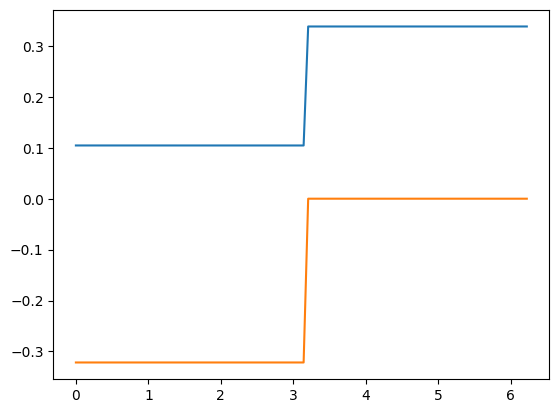
If the expansion point is \(Z\to\infty\) then we find that first two signs \(\sigma_1\), \(\sigma_2\) do not change the resulting expression, but that the sign \(\sigma_3\) dictates whether \(s(Z \to \infty)\) approaches either 0 (\(\sigma_3=+1\)) or \(\infty\) (\(\sigma_3=-1\)):
As we approach the singular points 0, 1, \(\infty\) from above/below the real axis, we find the following:
Similarly, the other two singular points are found to be
where \(h_1 := [(1-k)z_n-1]/2 \simeq 0.33826\ldots\), and where \(\epsilon >0\) and \(\pm\) dictates whether the singular point is approached from above/below. Since the values in the above with \(\sigma_3 = +1\) are antipodal to those with \(\sigma_3 = -1\) (and since \(z=0\) is antipodal to \(z\to\infty\)), we find that this sign determines whether the triangle under consideration lies either at the top or the bottom of the Riemann sphere. Lastly, the upper/lower half-planes must describe the mirror image of the fundamental triangle in the \(\xi\)-axis, since the vertex and midpoint do not move, as they are real, and the face centre goes from rotated up by \(e^{i\pi/5}\) to rotated down by the same amount.
1 / 0.3382617
2.9562909427818758
from itertools import product

eps = 1e-55j

for s1, s2, s3 in product([+1, -1], [+1, -1], [+1, -1]):
    print(
        s1,
        s2,
        s3,
        "F:",
        s_inv(eps, sg1=s1, sg2=s2, sg3=s3) * np.exp(-np.pi / 5 * 1j),
        s_inv(eps, sg1=s1, sg2=s2, sg3=s3) * np.exp(+np.pi / 5 * 1j),
        "E:",
        s_inv(1 + eps, sg1=s1, sg2=s2, sg3=s3),
        "V:",
        s_inv(1e55 + eps, sg1=s1, sg2=s2, sg3=s3),
        s_inv(-3 - 5j),
        s_inv(-3 + 5j),
    )
1 1 1 F: (0.1045284632676535-0.3217055305650853j) (0.3382612127177165+2.0165837040625896e-17j) E: (0.2840790438404124-2.0862790179196747e-29j) V: (2.251600064201026e-12-4.503200128402052e-123j) (0.14244767294577834+0.06602319464811653j) (0.14244767294577834-0.06602319464811653j)
1 1 -1 F: (-2.9562952014676105-5.875776049326388e-17j) (-0.9135454576426009-2.811603815447865j) E: (-3.520147021340201-2.585199095058965e-28j) V: (-444128606984.5832-8.882572139691663e-100j) (0.14244767294577834+0.06602319464811653j) (0.14244767294577834-0.06602319464811653j)
1 -1 1 F: (0.10452846326765503-0.32170553056508994j) (0.3382612127177213+3.3086219180672475e-17j) E: (0.2840790438404122-2.0862790179196752e-29j) V: (2.2516000642010035e-12-4.503200128402008e-123j) (0.14244767294577834+0.06602319464811653j) (0.14244767294577834-0.06602319464811653j)
1 -1 -1 F: (-2.9562952014675687+3.0909058052619345e-16j) (-0.9135454576425882-2.811603815447825j) E: (-3.520147021340202-2.5851990950589683e-28j) V: (-444128606984.5877-8.882572139691758e-100j) (0.14244767294577834+0.06602319464811653j) (0.14244767294577834-0.06602319464811653j)
-1 1 1 F: (0.10452846326765271-0.32170553056508305j) (0.3382612127177141-3.936897505271442e-17j) E: (0.2840790438404124+1.2402216765675661e-17j) V: (2.2516000642010184e-12-4.5032001284020385e-123j) (0.14244767294577834+0.06602319464811653j) (0.14244767294577834-0.06602319464811653j)
-1 1 -1 F: (-2.956295201467632-3.537042334655082e-16j) (-0.913545457642607-2.811603815447885j) E: (-3.5201470213402004+1.7059637197440578e-16j) V: (-444128606984.58466-8.882572139691698e-100j) (0.14244767294577834+0.06602319464811653j) (0.14244767294577834-0.06602319464811653j)
-1 -1 1 F: (0.10452846326765282-0.321705530565083j) (0.3382612127177141+7.652638782568283e-17j) E: (0.2840790438404124+2.8171771529931913e-17j) V: (2.2516000642010346e-12-4.503200128402069e-123j) (0.14244767294577834+0.06602319464811653j) (0.14244767294577834-0.06602319464811653j)
-1 -1 -1 F: (-2.956295201467631+5.34474186234617e-16j) (-0.9135454576426076-2.811603815447884j) E: (-3.520147021340201+3.908148273157554e-16j) V: (-444128606984.5815-8.882572139691629e-100j) (0.14244767294577834+0.06602319464811653j) (0.14244767294577834-0.06602319464811653j)
s_inv(-3 - 5j)
np.complex128(0.14244767294577834+0.06602319464811653j)
import numpy as np


def s_inv2(Z, sg1=+1, sg2=+1, sg3=+1):
    a, b, c = symbols("a b c")
    eq1 = Eq(c - a - b, sg1 * Rational(1, 2))
    eq2 = Eq(1 - c, sg2 * Rational(1, 3))
    eq3 = Eq(a - b, sg3 * Rational(1, 5))
    solns = solve([eq1, eq2, eq3], [a, b, c])
    a = float(solns[a])
    b = float(solns[b])
    c = float(solns[c])
    # a, b, c = 11 / 60, -1 / 60, 2 / 3
    num = hyp2f1(a, b, c, Z)
    denom = Z ** (1 - c) * hyp2f1(1 + a - c, 1 + b - c, 2 - c, Z)
    # print(num,denom)
    coeff = 1  # (1728) ** (1 / 5)
    # coeff = 0.284079041754133/0.70882405176421
    # coeff = 0.284079041754133 / 1.4107873420929684
    coeff = 0.338261212717716 / 2.586766338312561
    # coeff = 0.338261212717716 / 0.18448308813935999
    return coeff * np.divide(num, denom)


s_inv2(np.array([-1e-55j]))
array([2.43982662e+17+1.40863456e+17j])
(2.586766338312561 / 0.338261212717716) ** 6
199999.99999279383
0.338261212717716 / 2.586766338312561, 1 / (200000) ** (1 / 6)
(0.13076604860196833, 0.13076604860118307)
(0.284079043840412 / 1.4107873573583158)
0.20136205669743665
(0.338261212717716 / 0.18448308813935999) ** 6
37.99914721467943
from itertools import product

eps = -1e-55j

for s1, s2, s3 in product([+1, -1], [+1, -1], [+1, -1]):
    print(
        s1,
        s2,
        s3,
        "F:",
        s_inv2(eps, sg1=s1, sg2=s2, sg3=s3),
        "E:",
        s_inv2(1 + eps, sg1=s1, sg2=s2, sg3=s3),
        "V:",
        s_inv2(1e55 + eps, sg1=s1, sg2=s2, sg3=s3) * np.exp(-np.pi / 3 * 1j),
        s_inv2(1e55 + eps, sg1=s1, sg2=s2, sg3=s3) * np.exp(+np.pi / 3 * 1j),
    )
1 1 1 F: (2.4398266219041667e+17+1.4086345569323858e+17j) E: (0.09269011940029458+1.0029483789626555e-29j) V: (0.05055193685846039-2.2042011928602662e-13j) (-0.0252759684290393+0.04377926153004382j)
1 1 -1 F: (2.4398266219041667e+17+1.4086345569323858e+17j) E: (0.09269011940029454+1.002948378962655e-29j) V: (0.05055193685846039-2.2042011928602662e-13j) (-0.0252759684290393+0.04377926153004382j)
1 -1 1 F: (5.256447111893667e-20-3.034811155032838e-20j) E: (0.18448308813935999-1.99618918815216e-29j) V: (-0.16913060635758062-0.2929428033292114j) (0.33826121271771603+1.474920100812128e-12j)
1 -1 -1 F: (5.256447111893667e-20-3.034811155032838e-20j) E: (0.18448308813935999-1.99618918815216e-29j) V: (-0.16913060635758062-0.2929428033292114j) (0.33826121271771603+1.474920100812128e-12j)
-1 1 1 F: (2.4398266219041667e+17+1.4086345569323858e+17j) E: (0.09269011940029581-1.996147115210449e-17j) V: (0.0505519368584612-2.2039674490864953e-13j) (-0.02527596842903972+0.04377926153004451j)
-1 1 -1 F: (2.4398266219041667e+17+1.4086345569323858e+17j) E: (0.09269011940029581-1.996147115210449e-17j) V: (0.0505519368584612-2.2039674490864953e-13j) (-0.02527596842903972+0.04377926153004451j)
-1 -1 1 F: (5.256447111893667e-20-3.034811155032838e-20j) E: (0.18448308813935999-1.024086860531348e-17j) V: (-0.1691306063575802-0.2929428033292107j) (0.3382612127177152+1.474944404825014e-12j)
-1 -1 -1 F: (5.256447111893667e-20-3.034811155032838e-20j) E: (0.18448308813935999-1.024086860531348e-17j) V: (-0.1691306063575802-0.2929428033292107j) (0.3382612127177152+1.474944404825014e-12j)
0.520876591889109 / 0.2840790448279948
1.8335621770500221
val = s_inv2(1e55 - 1e-55j)
np.atan2(val.imag, val.real) / np.pi
np.float64(0.33333333333194537)
1 / (1728) ** (1 / 5)
0.2251600064201022
val23 / val12
np.float64(1.392382021468321)
theta = np.arccos((1 + np.sqrt(5)) / 2 / np.sqrt(3))
val23 = np.cos(theta) / (1 + np.sin(theta))
val23
np.float64(0.6885002580691648)
alpha = np.arccos(1 / 2 / np.sin(np.pi / 5))
theta = np.arccos((1 + np.sqrt(5)) / 2 / np.sqrt(3) * np.cos(alpha))
val12 = np.cos(theta) / (1 + np.sin(theta))
val12
np.float64(0.49447654986460865)
import matplotlib.pyplot as plt

exps = np.linspace(-20, 0, 100)
exps = exps
xs = np.pow(10, exps)
print(xs)
ys = s_inv(xs)
print(ys)
plt.scatter(xs, ys)
plt.xscale("log")
plt.show()
[1.00000000e-20 1.59228279e-20 2.53536449e-20 4.03701726e-20
 6.42807312e-20 1.02353102e-19 1.62975083e-19 2.59502421e-19
 4.13201240e-19 6.57933225e-19 1.04761575e-18 1.66810054e-18
 2.65608778e-18 4.22924287e-18 6.73415066e-18 1.07226722e-17
 1.70735265e-17 2.71858824e-17 4.32876128e-17 6.89261210e-17
 1.09749877e-16 1.74752840e-16 2.78255940e-16 4.43062146e-16
 7.05480231e-16 1.12332403e-15 1.78864953e-15 2.84803587e-15
 4.53487851e-15 7.22080902e-15 1.14975700e-14 1.83073828e-14
 2.91505306e-14 4.64158883e-14 7.39072203e-14 1.17681195e-13
 1.87381742e-13 2.98364724e-13 4.75081016e-13 7.56463328e-13
 1.20450354e-12 1.91791026e-12 3.05385551e-12 4.86260158e-12
 7.74263683e-12 1.23284674e-11 1.96304065e-11 3.12571585e-11
 4.97702356e-11 7.92482898e-11 1.26185688e-10 2.00923300e-10
 3.19926714e-10 5.09413801e-10 8.11130831e-10 1.29154967e-09
 2.05651231e-09 3.27454916e-09 5.21400829e-09 8.30217568e-09
 1.32194115e-08 2.10490414e-08 3.35160265e-08 5.33669923e-08
 8.49753436e-08 1.35304777e-07 2.15443469e-07 3.43046929e-07
 5.46227722e-07 8.69749003e-07 1.38488637e-06 2.20513074e-06
 3.51119173e-06 5.59081018e-06 8.90215085e-06 1.41747416e-05
 2.25701972e-05 3.59381366e-05 5.72236766e-05 9.11162756e-05
 1.45082878e-04 2.31012970e-04 3.67837977e-04 5.85702082e-04
 9.32603347e-04 1.48496826e-03 2.36448941e-03 3.76493581e-03
 5.99484250e-03 9.54548457e-03 1.51991108e-02 2.42012826e-02
 3.85352859e-02 6.13590727e-02 9.77009957e-02 1.55567614e-01
 2.47707636e-01 3.94420606e-01 6.28029144e-01 1.00000000e+00]
[       nan        nan        nan        nan        nan        nan
        nan        nan        nan        nan        nan        nan
        nan        nan        nan        nan        nan        nan
        nan        nan        nan        nan        nan        nan
        nan        nan        nan        nan        nan        nan
        nan        nan        nan        nan        nan        nan
        nan        nan        nan        nan        nan        nan
        nan        nan        nan        nan        nan        nan
        nan        nan        nan        nan        nan        nan
        nan        nan        nan        nan        nan        nan
        nan        nan        nan        nan        nan        nan
        nan        nan        nan        nan        nan        nan
        nan        nan        nan        nan        nan        nan
        nan        nan        nan        nan        nan        nan
        nan        nan        nan        nan        nan        nan
        nan        nan        nan        nan        nan        nan
        nan        nan        nan 0.28407904]
/var/folders/8g/byx83mzd7gz503xq8dj4cjr40000gp/T/ipykernel_65992/594549837.py:19: RuntimeWarning: invalid value encountered in divide
  return coeff * np.divide(num , denom)
for s1, s2, s3, exp in product([+1, -1], [+1, -1], [+1, -1], [0, 1, oo]):
    get_soln(1, 1, 1, oo)(-1e-55 * I)
from sympy import I, exp, pi

expr = get_soln(1, 1, 1, oo)(z)
(expr.subs(z, -0.000000001 - 0.00000000 * I) * exp(-I * pi / 5)).evalf()
c = _
s = symbols("s")
solve(c / s ** (1 / 5) - 0.284079043840412, s)
[]
alpha = np.arccos(1 / 2 / np.sin(np.pi / 5))
n3 = (
    2
    / np.sqrt(3)
    * np.array(
        [
            -np.sin(alpha) * np.cos(np.pi / 5),
            np.sin(alpha) * np.sin(np.pi / 5),
            np.cos(alpha) * np.cos(np.pi / 5),
        ]
    )
)
n2 = np.array([-np.sin(alpha), 0, np.cos(alpha)])
dp = np.dot(n2, n3)
print(dp)
cp = np.cross(n2, n3)
theta = np.arccos(dp)
yp = cp / np.sin(theta)
# xp = (n2 - dp*n3)/np.sqrt(2*(1-dp**2))
np.linalg.norm(yp), np.linalg.norm(n3), np.linalg.norm(n2)
0.9341723589627158
(np.float64(1.000000000000001),
 np.float64(1.0000000000000002),
 np.float64(1.0))
xp = np.cross(yp, n3)
np.linalg.norm(yp)
np.float64(1.000000000000001)
xp, yp, n3
(array([ 0.18759247,  0.93417236, -0.303531  ]),
 array([-0.85065081,  0.        , -0.52573111]),
 array([-0.49112347,  0.35682209,  0.79465447]))
O = np.vstack((xp, yp, n3))
O
array([[ 0.18759247,  0.93417236, -0.303531  ],
       [-0.85065081,  0.        , -0.52573111],
       [-0.49112347,  0.35682209,  0.79465447]])
zp = O @ np.array([0, 0, 1])
zp
array([-0.303531 , -0.52573111, 0.79465447])
zp = -zp
zpz = (zp[0] + I * zp[1]) / (1 - zp[2])
zpz
(zpz * exp(-I * pi / 3)).evalf()
n2p = O @ n2
n2p = -n2p
n2pz = (n2p[0] + I * n2p[1]) / (1 - n2p[2])
n2pz
O @ n3, O @ n2
(array([5.55111512e-17, 5.55111512e-17, 1.00000000e+00]),
 array([-3.56822090e-01,  5.55111512e-17,  9.34172359e-01]))
-n3p[0] / (1 + n3p[2])
np.float64(0.1252004517810262)
(1 + np.sqrt(5)) / 2 / np.sqrt(3)
np.float64(0.9341723589627158)
u, v, z, z_n = symbols("u v z z_n")

f = u * v * (u**10 + 11 * u**5 * v**5 - v**10)
H = (
    u**30
    + 522 * (u**25 * v**5 - u**5 * v**25)
    - 10005 * (u**20 * v**10 - u**10 * v**20)
    + v**30
)
F = u**20 - 228 * (u**15 * v**5 - u**5 * v**15) + 494 * u**10 * v**10 + v**20
from utils import z_simp

num = z_simp((F**3).subs(u, z * z_n + 1).subs(v, z - z_n).expand(), z_n)
num
_ / 15693023681640625
denom = z_simp((f**5).subs(u, z * z_n + 1).subs(v, z - z_n).expand(), z_n)
denom
z_simp(denom * denom.subs(z_n, -1 - z_n), z_n)
(f**5).subs(u, z).subs(v, 1).factor()
z_simp(num * denom.subs(z_n, -1 - z_n), z_n)
(931322574615478515625 * F**3 * f**5).subs(u, z).subs(v, 1).expand()
z_simp(num * denom.subs(z_n, -1 - z_n), z_n).expand().equals(
    (931322574615478515625 * F**3 * f**5).subs(u, z).subs(v, 1).expand()
)
True
_ / 15693023681640625
25391845703125000 / 15693023681640625
1.6180339887482036